Paradise Valley is the most land-restricted, wealth-concentrated municipality in Arizona. Its 15,000 residents live on properties that, on average, command more per square foot than anywhere else in the Sonoran Desert. And yet, for years, the landscape was often the last consideration — something specified late in the build process, assigned whatever budget remained after the interior was finished.
That era is over. The new generation of Paradise Valley and Scottsdale estate owners understands what the finest resort designers have always known: the outdoor environment is the frame through which the home is experienced. Get it right and the architecture breathes. Get it wrong and no amount of interior design rescues the impression.
Here is what is defining the next chapter of luxury landscape design in the valley — and why it matters for the value and livability of your estate.
1. Desert Modernism Has Come of Age
Ten years ago, "desert landscaping" in Paradise Valley largely meant decomposed granite, a few saguaros, and a row of bougainvillea along the wall. That default vocabulary has been comprehensively replaced by something far more considered: desert modernism.
Desert modernism is not simply a plant list. It is a design philosophy that takes the Sonoran Desert's extraordinary plant material — the sculptural saguaro, the explosive agave, the feathery palo verde — and composes them with the same rigor an architect applies to a floor plan. The result is landscapes that feel simultaneously wild and precise, deeply rooted in place yet unmistakably sophisticated.
The most compelling desert modern landscapes we are completing in Scottsdale and Paradise Valley share several qualities: a considered relationship between hardscape and planting, where stone and gravel are not filler but ground plane; a commitment to scale, with specimen plants large enough to command the spaces they inhabit; and a restraint in the plant palette that lets each specimen read clearly rather than disappearing in a crowded bed.
"The best desert landscapes feel inevitable — as though the Sonoran Desert itself decided to organize into an estate garden. That is the standard we set for every Paradise Valley project."
2. The Indoor-Outdoor Merge Is Now Expected
The great Arizona climate advantage — roughly 300 days of outdoor-quality weather per year — is finally being fully capitalized on in estate design. Walls of glass that open entirely to outdoor living spaces, level transitions between interior and exterior flooring materials, and ceiling treatments that carry from indoors out are all standard requests from our clients in DC Ranch and Silverleaf.
What this means for landscape architecture is that the outdoor room must be designed with the same granularity as the interior. Furniture selection, lighting levels, acoustic considerations, heating for shoulder months, and shading for summer afternoons all require explicit specification. The landscape architect and the interior designer must work from the same brief, often the same mood board, to achieve true cohesion.
Our most sophisticated recent projects in Paradise Valley have eliminated the traditional boundary between "interior designer scope" and "landscape architect scope." The result is an estate that feels like one continuous, curated environment rather than a house next to a yard.
3. Resort-Level Pool and Water Feature Design
The infinity-edge pool with a mountain backdrop has been a Paradise Valley hallmark for decades. What has changed is the sophistication of what surrounds it and integrates with it.
Current estate pool landscapes incorporate layered water features — sheet descents into the pool, raised spa spillways, and fire-and-water combinations that create dramatic focal points from inside the home as well as from the pool deck. Baja shelves have become standard rather than a premium add-on. Swim-up bars with outdoor kitchen integration are requested as often as not on Paradise Valley properties at the $5M+ price point.
Pool deck materials have also evolved significantly. We are specifying fewer traditional travertine and more large-format porcelain tile in warm stone patterns, cool-surface treated concrete, and custom cut limestone that coordinates precisely with the home's architectural vocabulary. The pool area is now understood as an architectural space, not a utility.
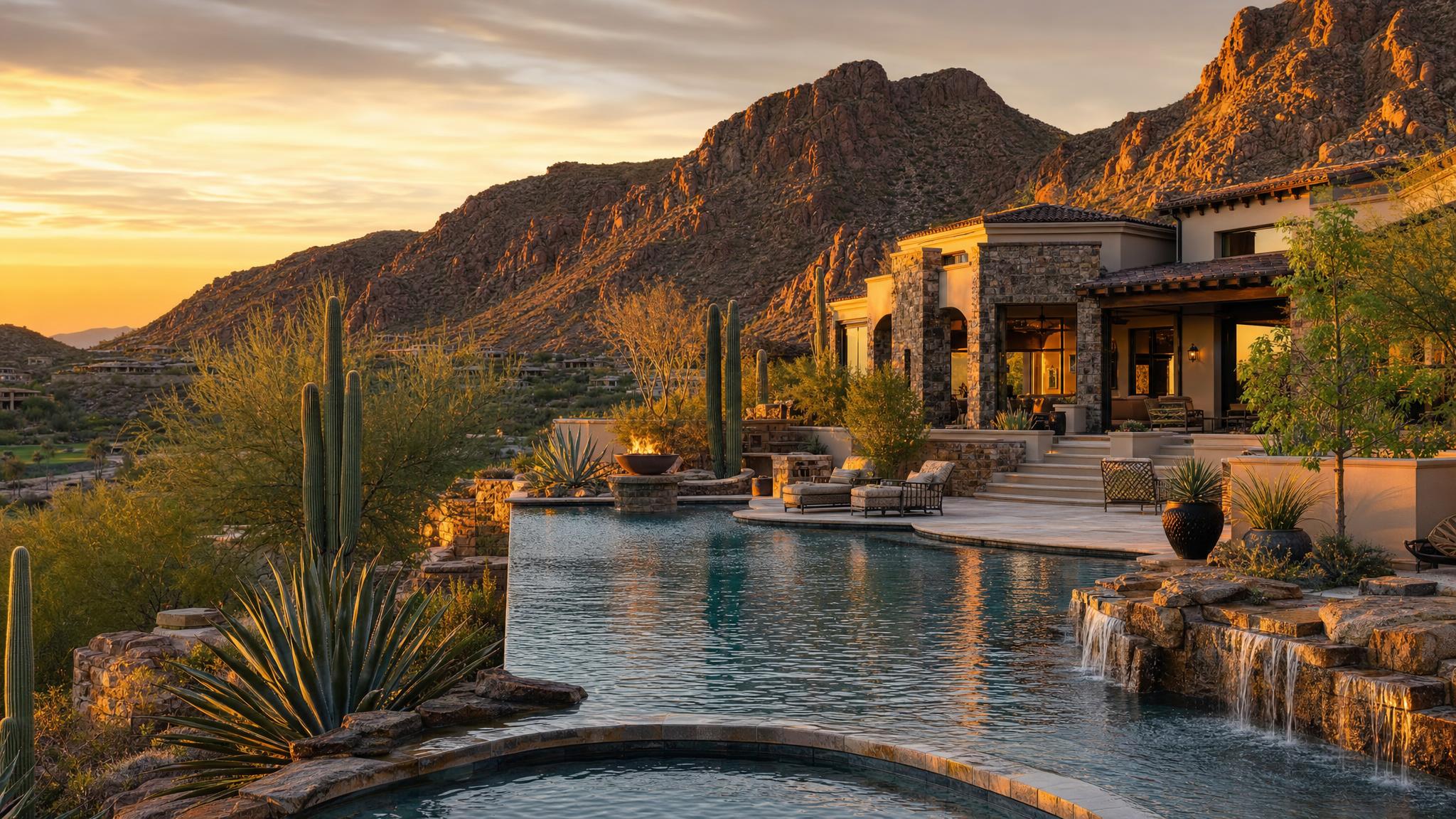
Resort-level pool and outdoor living design — a standard for Paradise Valley estate landscapes.
4. Biophilic Design Principles Are Driving Plant Selection
Biophilic design — the integration of natural systems and living material to support human wellbeing — has moved from academic theory to client brief. Paradise Valley homeowners are specifically requesting landscapes that feel immersive and restorative, not merely ornamental.
In practice, this means several things. Canopy is being prioritized: mature trees that provide genuine shade and a sense of enclosure under the Sonoran sky. Native plant communities are being referenced rather than abandoned — a biophilic desert landscape does not try to pretend it is in Italy, it finds the beauty in what Arizona actually is. And sensory richness is specified alongside visual beauty: fragrant plants like Texas Ranger, Salvia, and Hopseed Bush near outdoor seating; water sounds audible from interior rooms; textural contrasts between smooth stone and fine-leafed plants.
The research behind biophilic design is compelling: properties that incorporate mature canopy, water features, and rich planting are demonstrably more restorative to inhabit. In a market where estate buyers have access to the best interiors money can buy, this experiential quality becomes a meaningful differentiator.
5. Smart Water Management Is Non-Negotiable
Arizona's water situation is not a future concern — it is the present reality. The Colorado River compact, Scottsdale's reclaimed water program, and increasing municipal restrictions on landscape water use are all active considerations for every estate project we undertake.
The good news: smart water management technology has advanced to the point where an estate landscape can be genuinely water-responsible without any sacrifice to visual quality. ET-based (evapotranspiration) irrigation controllers adjust watering schedules in real time based on weather data. Soil moisture sensors prevent overwatering. Pressure-compensating emitters ensure uniform delivery regardless of topographic variation.
For our Paradise Valley clients, we specify systems that are both intelligent and remotely manageable — accessible from a phone regardless of where you are in the world. The days of scheduling an irrigation walkthrough around a client's travel calendar are behind us.
6. Night Lighting Has Become an Architectural Discipline
Estate homes in Paradise Valley are architectural statements. They deserve a lighting design that honors that architecture after dark, not a collection of path lights and bullet fixtures aimed vaguely upward into trees.
The landscape lighting discipline has matured significantly. We are working with lighting designers who approach the exterior with the same intentionality a theatrical lighting designer brings to a stage set. Key specimens are uplighted with precise beam control to create shadow play against walls. Architectural elements — columns, water features, gate details — are illuminated with fixtures that disappear during the day. Color temperature is controlled throughout, with warm tones (2700K–3000K) near living spaces and cooler temperatures reserved for accent effects.
The result, when done well, is an estate that is arguably more dramatic at night than during the day. Mountain views that disappear into darkness become framed compositions. The pool becomes a luminous centerpiece. And the home itself reads as the intentional architectural statement it was designed to be.
7. HOA Compliance as a Design Opportunity
DC Ranch, Silverleaf, and Gainey Ranch all maintain landscape guidelines that can feel, to the uninitiated, like constraints. In practice, the HOA standards in these communities were written to protect property values and community character — and working within them, or leveraging them as a design framework, consistently produces better outcomes than working against them.
We have completed dozens of projects in these communities and have developed deep familiarity with each HOA's approval process, its architectural review committee's preferences, and the specific requirements that distinguish compliant from non-compliant landscape plans. For new construction especially, early HOA engagement prevents costly revisions late in the design process.
What This Means for Your Estate
If you are planning a new estate landscape — whether for a new build, a complete redesign, or a significant enhancement — the trends above point toward a single conclusion: the investment in professional landscape architecture and high-quality installation pays returns far beyond the aesthetic.
A master-planned, well-executed estate landscape in Paradise Valley or North Scottsdale increases property value, extends your usable living space into the extraordinary Arizona outdoors, reduces long-term maintenance costs through smart irrigation and appropriate plant selection, and simply makes the experience of living in your home profoundly better.
We would be honored to discuss your project. Our consultations are private, unhurried, and focused entirely on understanding your property and your vision.